
Sample report
A PDF report after every scan
Each scan produces a PDF with an executive summary and every finding from that scan ranked by severity with its fix. Combine scanners for the port and TLS checks auditors ask for. Schedule scans daily, weekly, or monthly and set who receives the report by email.
The targets and dates in this sample are examples. White-label reports with your own branding are on the Professional plan.
Inside the PDF
Nine sections from summary to glossary
An executive summary, the vulnerabilities for each target, one section per scanner, and a glossary. Every vulnerability has a description and a solution, so engineers can work from the PDF without an account.
Executive summary, page 3
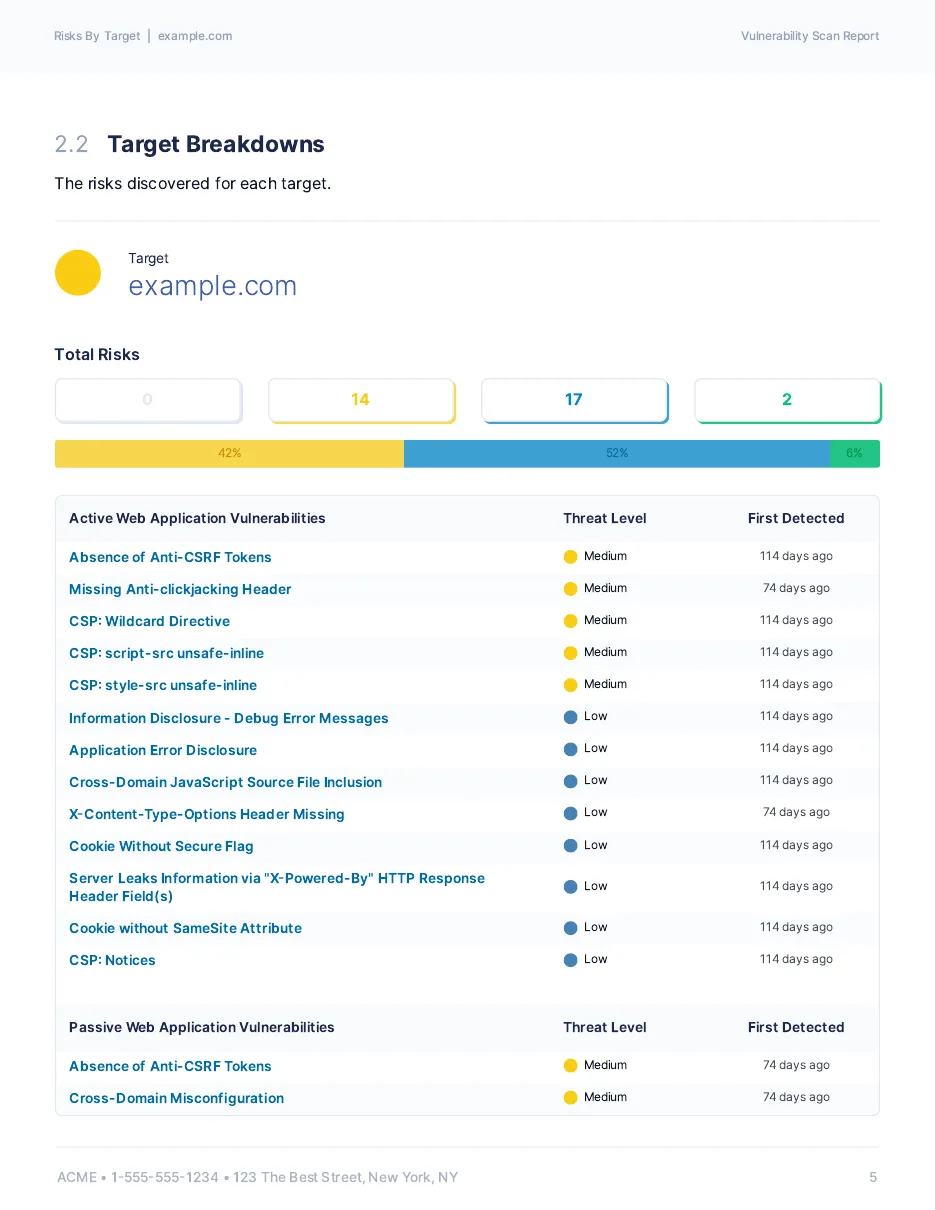
Vulnerabilities by target, page 5
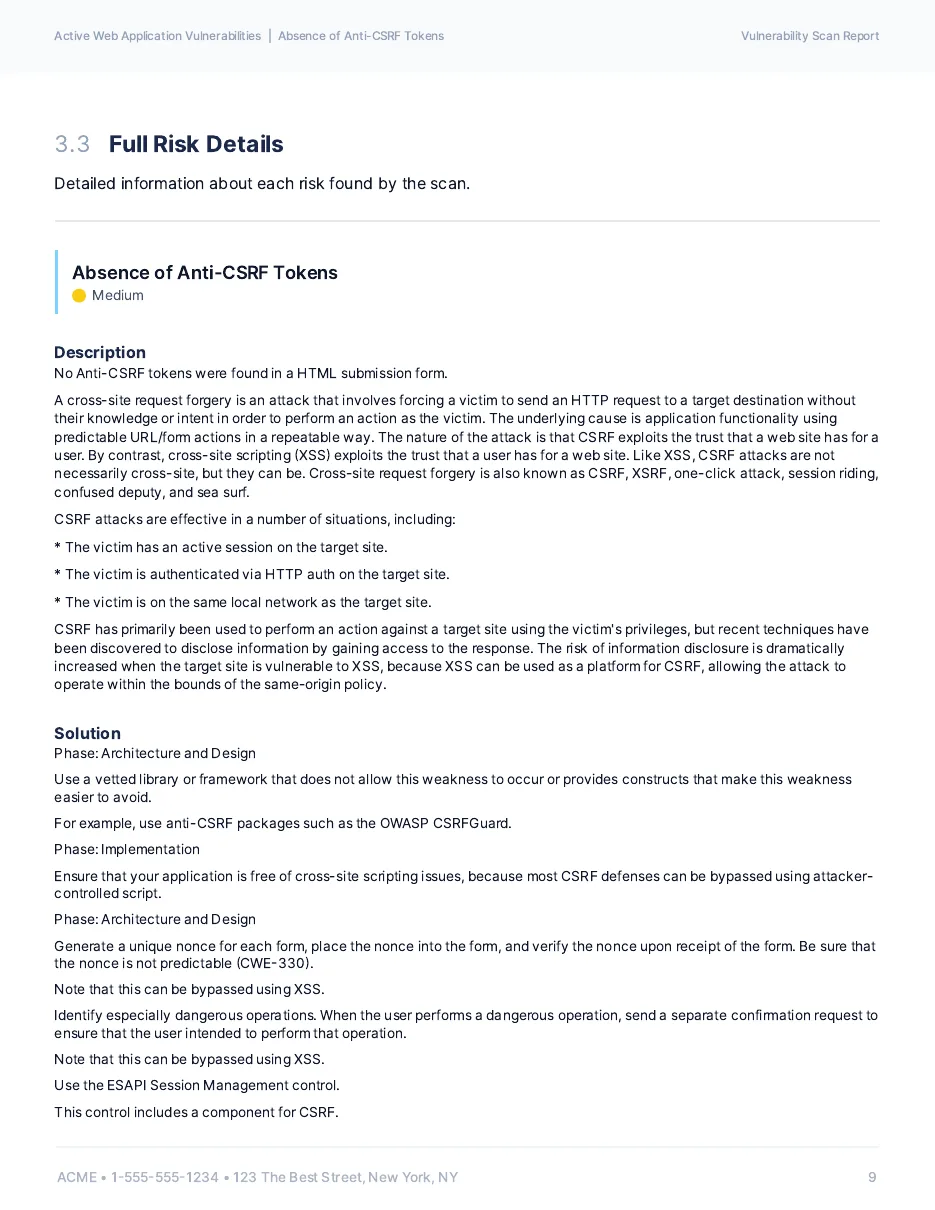
Vulnerability details, page 10
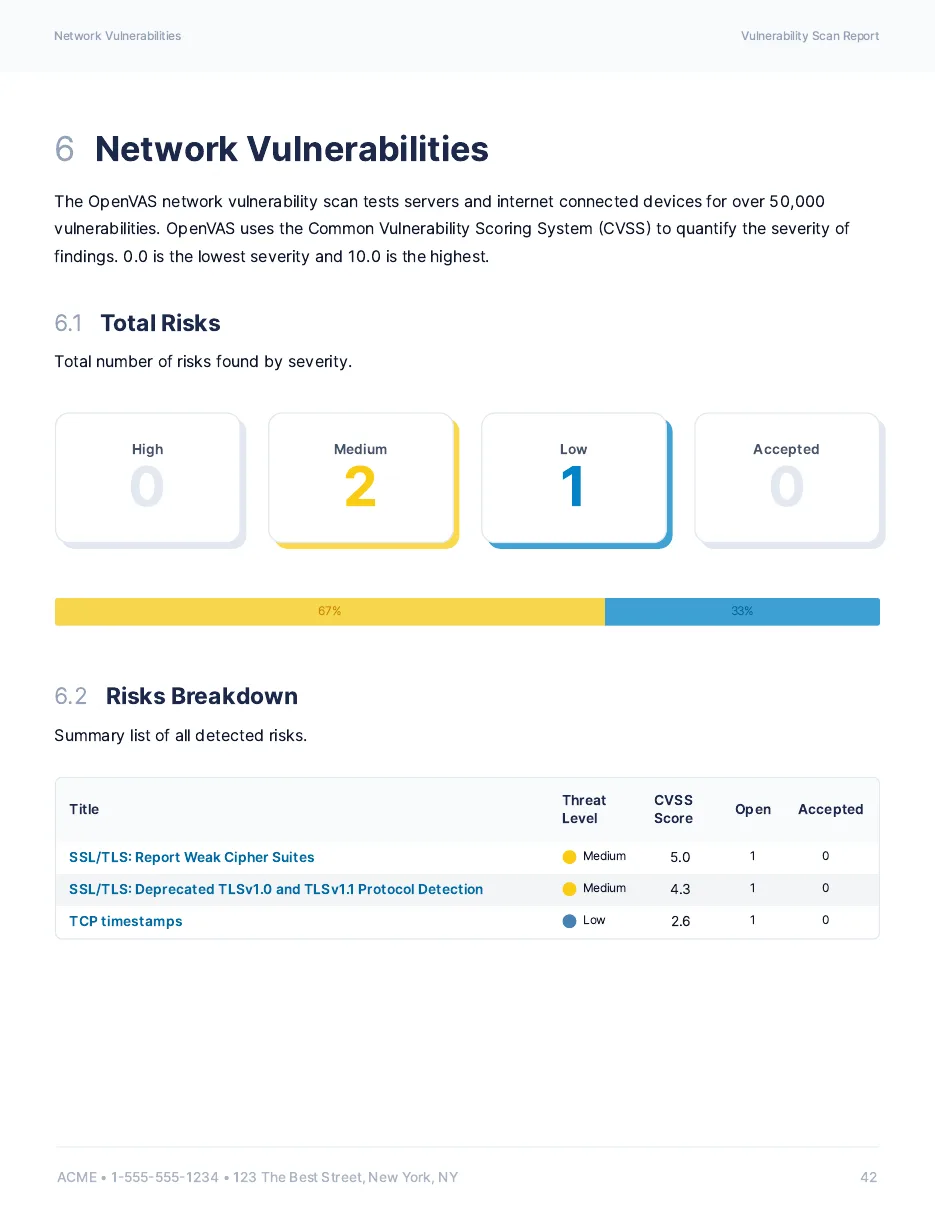
Network vulnerabilities, page 43
- 1.0
Executive summaryp. 3
Totals by severity across every target, what an accepted vulnerability means, and how many each scanner found.
- 2.0
Vulnerabilities by targetp. 4
A severity table per target, then every vulnerability grouped by scan type with its severity and first-detected date.
- 3.0
Active web application vulnerabilitiesp. 8
OWASP ZAP submits requests and forms to test for SQL injection, remote command execution, XSS, and more.
- 4.0
Passive web application vulnerabilitiesp. 24
OWASP ZAP inspects pages, requests, and responses for cross-domain misconfigurations, insecure cookies, and vulnerable JavaScript dependencies.
- 5.0
SSL/TLS securityp. 42
SSLyze checks for misconfigured or expired certificates, weak ciphers, and vulnerabilities such as Heartbleed.
- 6.0
Network vulnerabilitiesp. 43
OpenVAS tests servers and internet-connected devices for over 150,000 vulnerabilities, each scored with CVSS.
- 7.0
Open TCP portsp. 47
Nmap scans all 65,535 TCP ports and lists every open one.
- 8.0
Open UDP portsp. 50
Nmap checks for open ports on common UDP services.
- 9.0
Glossaryp. 51
Plain definitions of every term in the report, from accepted vulnerability to severity.
Sections 3 to 6 end with full details for each vulnerability found: a description, a solution, the targets it affects, and when it was first detected. Sections 7 and 8 list the open ports.
From page 3 of the sample report
Executive summary
1.0 Executive summary
No critical or high vulnerabilities on this scan. The 14 medium findings are mostly weak or missing security headers and absent anti-CSRF tokens, plus two weak TLS settings. The 2 accepted vulnerabilities are the open ports 80 and 443, reviewed by the team and excluded from the open counts.
- Generated
- September 24, 2026
- Target
- example.com
- Scanners
- OWASP ZAP, SSLyze, OpenVAS, Nmap
1.1 Total vulnerabilities
critical
0
high
0
medium
14
low
17
accepted
2
hostedscan.com
3
From pages 4 to 7 of the sample report
Vulnerabilities by target
2.0 Vulnerabilities by target
Each target lists its vulnerabilities by scan type, with the severity and when each was first detected. OpenVAS network findings also carry a CVSS score.
2.1 Targets summary
The number of potential vulnerabilities found for each target by severity.
| target | critical | high | medium | low | accepted |
|---|---|---|---|---|---|
| example.com | 0 | 0 | 14 | 17 | 2 |
2.2 Target breakdowns
Details for the potential vulnerabilities found for each target by scan type.
| Active Web Application Vulnerabilitieslast scanned: 09/24/2026 | severity | first detected |
|---|---|---|
| Absence of Anti-CSRF Tokens | medium | 06/02/2026 |
| Missing Anti-clickjacking Header | medium | 07/12/2026 |
| Passive Web Application Vulnerabilitieslast scanned: 09/24/2026 | severity | first detected |
| Cross-Domain Misconfiguration | medium | 07/12/2026 |
| Network Vulnerabilitieslast scanned: 09/24/2026 | severity | first detected |
| SSL/TLS: Report Weak Cipher Suitescvss score: 5.0 | medium | 07/12/2026 |
| SSL/TLS: Deprecated TLSv1.0 and TLSv1.1 Protocol Detectioncvss score: 4.3 | medium | 07/12/2026 |
hostedscan.com
4 to 7
The other 9 medium and 17 low-severity findings, each with its full description and solution, are in the PDF.
From page 42 of the sample report
SSL/TLS security
5.0 SSL/TLS security
SSLyze checks for misconfigured or expired certificates, weak ciphers, and vulnerabilities such as Heartbleed. It found nothing on example.com. The weak cipher suites and the TLS 1.0 and 1.1 support above come from the OpenVAS network scan.
5.2 Vulnerabilities breakdown
Summary list of all detected vulnerabilities.
| title | severity | open | accepted |
|---|---|---|---|
| No vulnerabilities detected | |||
hostedscan.com
42
From pages 47 to 49 of the sample report
Open TCP ports
7.0 Open TCP ports
Nmap scans all 65,535 TCP ports and lists every open one. Both open ports were reviewed and accepted, so they are not counted as open vulnerabilities.
7.2 Vulnerabilities breakdown
Summary list of all detected vulnerabilities.
| title | severity | open | accepted |
|---|---|---|---|
| Open TCP Port: 443 | medium | 0 | 1 |
| Open TCP Port: 80 | medium | 0 | 1 |
hostedscan.com
47 to 49
Free trial
Try it on your own targets
Scan your websites, servers, networks, and APIs with every scanner in the Premium plan.
14 days free. No credit card required.
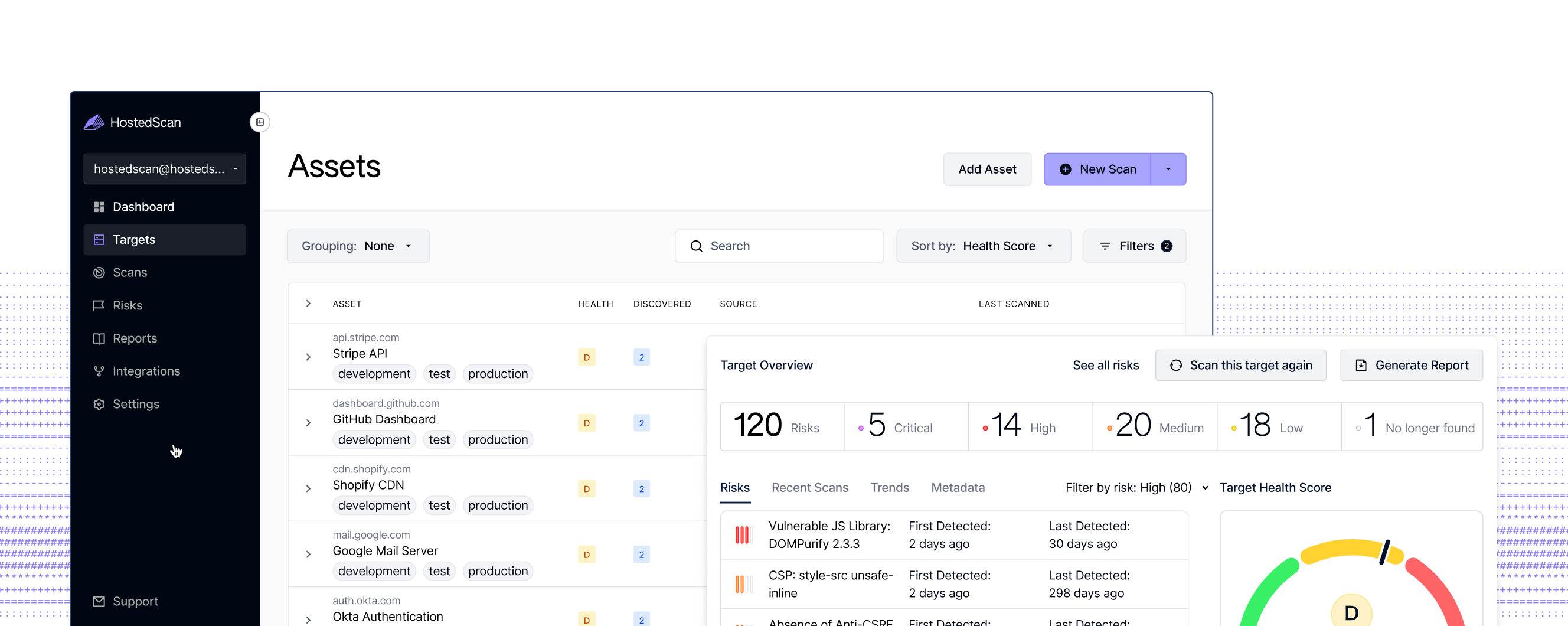
Speed and power,
without the complexity
The world's leading vulnerability scanners, all in one platform.